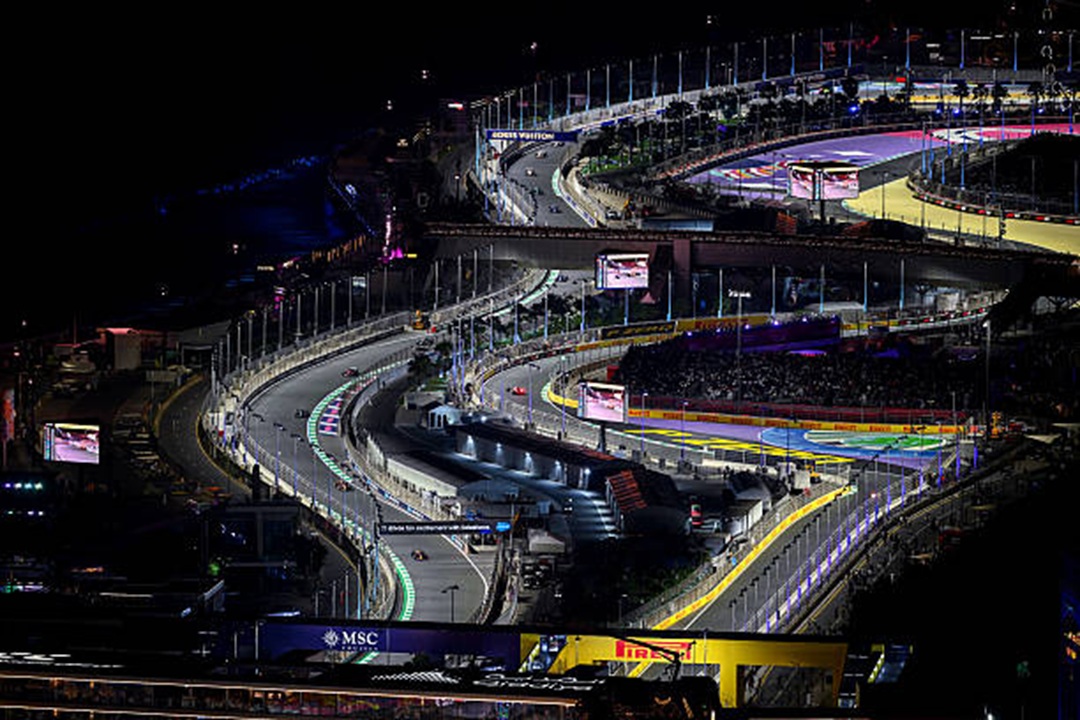
JEDDAH, SAUDI ARABIA – APRIL 20: Max Verstappen of the Netherlands driving the (1) Oracle Red Bull Racing RB21 leads Oscar Piastri of Australia driving the (81) McLaren MCL39 Mercedes and George Russell of Great Britain driving the (63) Mercedes AMG Petronas F1 Team W16 on track during the F1 Grand Prix of Saudi Arabia at Jeddah Corniche Circuit on April 20, 2025 in Jeddah, Saudi Arabia. (Photo by Clive Mason/Getty Images)
There are moments in Formula 1 when the noise stops. The turbocharged symphony goes quiet. The champagne corks stay stubbornly in place. The entire circus — usually storming into a city like caffeinated rock stars — suddenly decides to stay home. That’s what’s happening in the Middle East this April.
The FIA confirmed it Saturday: the Bahrain Grand Prix and the Saudi Arabian Grand Prix are off. No substitutes, no Plan B, no last‑minute miracle involving a shopping mall parking lot. Formula 2, Formula 3, and F1 Academy rounds are also benched, left to stare at their tires. In short, the greatest show on wheels will slam on the brakes.
Stefano Domenicali, F1’s President and CEO, called it a “difficult decision.” Which is like saying a tornado is “a bit breezy.” He thanked promoters for their understanding and promised a triumphant return when the dust settles. Meanwhile, FIA President Mohammed Ben Sulayem reminded everyone that safety comes first. And with hundreds of millions of dollars’ worth of carbon fiber, electronics, and fragile egos involved, that’s comforting.
Bahrain and Jeddah have become crucial early-season landmarks. Bahrain, with its desert-night drama, tires screaming like cats on a tin roof. Jeddah, a street circuit so fast and unforgiving it could give Monaco a nervous breakdown after three espressos. Losing both is a jolt, but the season isn’t dead. China is happening this weekend, and Japan waits in two weeks, ready to remind everyone that F1 can still be furious and chaotic even without sand in the air.
Sheikh Salman bin Isa Al Khalifa of Bahrain International Circuit offered full support and thanked fans for their solidarity. HRH Prince Khalid bin Sultan Al-Abdullah Al-Faisal of the Saudi Motorsport Federation acknowledged disappointment, but promised the desert will roar again.
Cancellations are still unnerving — F1 prides itself on resilience. It has raced through monsoons, political unrest, and, recently, a pandemic that had calendar rewrites like a tabloid chasing scandal. Yet when the engines stop, it’s always for a reason that hits harder than a high‑speed T‑bone.
Momentum, in racing, is a fragile creature. Drivers expecting early-season glory will now cool their heels. Teams will retreat to factories, poring over telemetry like medieval monks searching for hidden meaning. Fans? They’ll wait. Impatiently. Loudly. Probably while arguing on social media and spilling coffee on their keyboards.
Because Formula 1 isn’t just about speed. It’s about anticipation.
And right now, with China roaring this weekend and Japan looming, then the world will wait. The engines will fire again. The desert will return. And when it does, it will be loud, it will be glorious, and it will make anyone who thought cancellations were a tragedy feel very, very small.

Greg was a writer for DriveTribe supporting Amazon's The Grand Tour and has been published in major publications across the country including the Los Angeles Times, the Cleveland Plain Dealer and the Atlanta Journal-Constitution. He was also a contributor to Chicken Soup for the NASCAR Soul, published in 2010, and the Christmas edition in 2016. He wrote as the NASCAR, Formula 1, Auto Reviews and National Veterans Affairs Examiner for Examiner.com and has appeared on Fox News. He holds a BS degree in communications, a Masters degree in psychology. He is currently the weekend Motorsports Editor for Autoweek and a regular contributor to Forbes.
- Bahrain and Jeddah Off the F1 Calendar, But the Championship Won’t Sit Still - March 14, 2026
- Caraganza Review 2026 Cadillac Escalade IQ: Nine Thousand Pounds of Electric Swagger - March 8, 2026
- Russell Beats Ferrari’s Early Charge As Mercedes Flexes Its Muscles In Australian Grand Prix - March 8, 2026